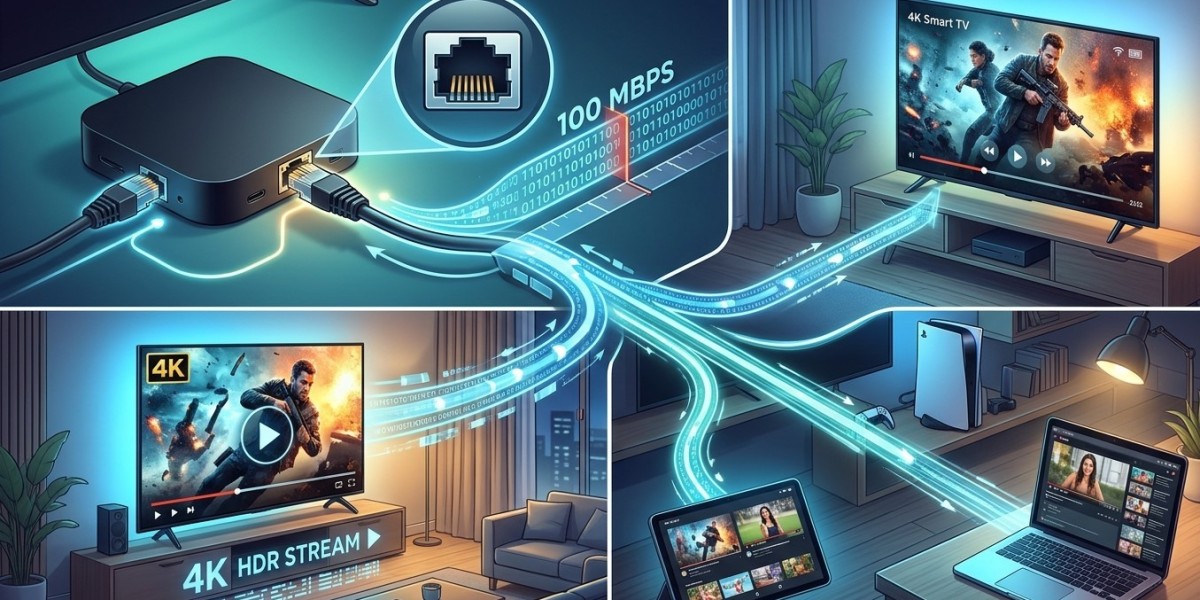

When checking the specifications of an IPTV box, you may notice that its Ethernet port supports only 100 Mbps instead of 1 Gbps (Gigabit Ethernet). This can raise questions, especially if you have a high-speed internet plan and want smooth streaming without buffering.
However, a 100 Mbps Ethernet connection is not necessarily a limitation for everyday television viewing. Most streaming activities require considerably less bandwidth than many people expect. What matters is whether your connection can consistently deliver enough speed for your content and household usage.
Whether you watch television through IPTV India or use an Indian IPTV Box, understanding Ethernet speeds can help you decide whether your current device is suitable for your entertainment needs.
Table of Contents
What Does a 100 Mbps Ethernet Port Mean?
Is 100 Mbps Enough for IPTV Streaming?
Why Do Some IPTV Boxes Have 100 Mbps Ports?
Does Gigabit Ethernet Improve Streaming Quality?
How to Check Your Ethernet Connection Speed
Tips for Getting Better Streaming Performance
Frequently Asked Questions
1. What Does a 100 Mbps Ethernet Port Mean?
An Ethernet port rated at 100 Mbps supports a maximum theoretical connection speed of 100 megabits per second.
It is commonly known as Fast Ethernet. By comparison, Gigabit Ethernet supports up to 1,000 Mbps, which is ten times the theoretical maximum.
Here is a simple comparison:
| Ethernet type | Maximum theoretical speed |
|---|---|
| Fast Ethernet | 100 Mbps |
| Gigabit Ethernet | 1,000 Mbps |
| 2.5 Gigabit Ethernet | 2,500 Mbps |
Actual performance may be lower because of network overhead, cable quality, router capabilities, and other technical factors.
A 100 Mbps port does not mean your internet connection is slow. It simply limits the maximum speed available through that particular wired connection.
2. Is 100 Mbps Enough for IPTV Streaming?
For most ordinary IPTV viewing, 100 Mbps is more than sufficient.
Streaming requirements vary depending on video resolution, compression, frame rate, and service quality. Typical approximate bandwidth requirements include:
SD streaming: Around 2–5 Mbps
HD streaming: Around 5–10 Mbps
4K streaming: Around 15–25 Mbps or more
These figures are general estimates, not guaranteed requirements for every service.
Even a high-quality 4K stream will often operate comfortably within a stable 100 Mbps Ethernet connection.
For example, if a stream requires 20 Mbps, a properly functioning 100 Mbps connection has enough theoretical capacity to handle it. However, other devices and network activity can also consume bandwidth.
3. Why Do Some IPTV Boxes Have 100 Mbps Ports?
Manufacturers choose hardware specifications based on cost, device design, and expected usage.
There are several reasons an IPTV box may include Fast Ethernet:
Lower manufacturing costs: 100 Mbps components can be less expensive.
Typical streaming requirements: Many streaming services do not need Gigabit speeds.
Hardware limitations: Some entry-level chipsets support only Fast Ethernet.
Product positioning: Budget-friendly devices may prioritize essential streaming features.
A 100 Mbps port is not automatically a sign of poor-quality hardware. Other specifications, including processor performance, memory, software support, and video decoding capabilities, also matter.
4. Does Gigabit Ethernet Improve Streaming Quality?
Gigabit Ethernet offers a higher maximum connection speed, but that does not automatically mean better picture quality.
If your IPTV stream requires only 15–25 Mbps and your 100 Mbps connection is stable, upgrading to Gigabit Ethernet may provide little noticeable improvement.
Gigabit Ethernet becomes more useful when:
You transfer large files over your local network.
Multiple devices access a network storage system.
You stream high-bitrate media from a local server.
Your home network regularly requires more than 100 Mbps.
You want additional capacity for future network needs.
For normal IPTV viewing, connection stability is often more important than having the highest possible Ethernet speed.
5. How to Check Your Ethernet Connection Speed
You can check whether your IPTV box is connecting at the expected speed.
Follow these steps:
Connect the box directly to your router using an Ethernet cable.
Check the Ethernet status in the device's network settings, if available.
Review the router's connected-device information.
Run a speed test using a supported application or another device connected to the same network.
Compare the results with your internet plan and expected connection speed.
Remember that an internet speed test measures the available internet throughput, not necessarily the Ethernet port's maximum hardware capability.
A 100 Mbps port may show a practical speed below 100 Mbps because of network overhead.
6. Tips for Getting Better Streaming Performance
Even with a 100 Mbps Ethernet port, you can improve your streaming experience through simple network practices.
Use a good-quality Ethernet cable, preferably Cat5e or better.
Connect your IPTV box directly to the router when possible.
Avoid damaged or loosely connected cables.
Keep your router firmware updated.
Pause unnecessary large downloads during important live streams.
Restart networking equipment when troubleshooting connection problems.
Check whether your service provider is experiencing an outage.
If your connection is stable but buffering continues, investigate other possible causes, such as streaming-server performance, application problems, or device limitations.
Frequently Asked Questions
1. Is a 100 Mbps Ethernet port enough for 4K streaming?
Yes. A stable 100 Mbps connection is generally sufficient for a typical 4K stream, although actual requirements depend on the content and streaming service.
2. Will a Gigabit Ethernet adapter make my 100 Mbps IPTV box faster?
Not necessarily. If the device's internal hardware or USB interface limits network performance, an external adapter may not provide any improvement. Check manufacturer compatibility first.
3. Can a 100 Mbps Ethernet port cause buffering?
It can become a limitation if the combined bandwidth demand exceeds its practical capacity. However, ordinary single-stream IPTV viewing usually requires much less bandwidth.
4. Which Ethernet cable should I use for my IPTV box?
A good-quality Cat5e or Cat6 cable is suitable for most home streaming connections. The cable cannot increase a device's 100 Mbps port limit, but it can help provide a reliable connection.
5. Should I buy a new IPTV box with Gigabit Ethernet?
Only if your usage requires the additional network capacity or you need other improved hardware features. For ordinary HD and 4K streaming, a stable 100 Mbps connection is generally enough.
Conclusion and Call to Action
A 100 Mbps Ethernet port may sound outdated compared with modern Gigabit networking, but it is still capable of supporting most everyday IPTV streaming requirements. A stable wired connection, suitable Ethernet cable, and reliable internet service are usually more important than simply having a higher port speed.
Before upgrading your equipment, consider your actual streaming needs and check whether your existing connection is performing properly. Enjoy your favorite entertainment through IPTV India and a compatible Indian IPTV Box with a network setup designed for smooth and dependable viewing.