
Real estate tokenization has gained attention among property owners, investment firms, developers, and financial businesses that want to offer fractional ownership through blockchain technology. A tokenization platform can provide a digital environment where eligible properties are represented through blockchain-based tokens, investors can purchase fractional interests, and transactions can be recorded through smart contracts.
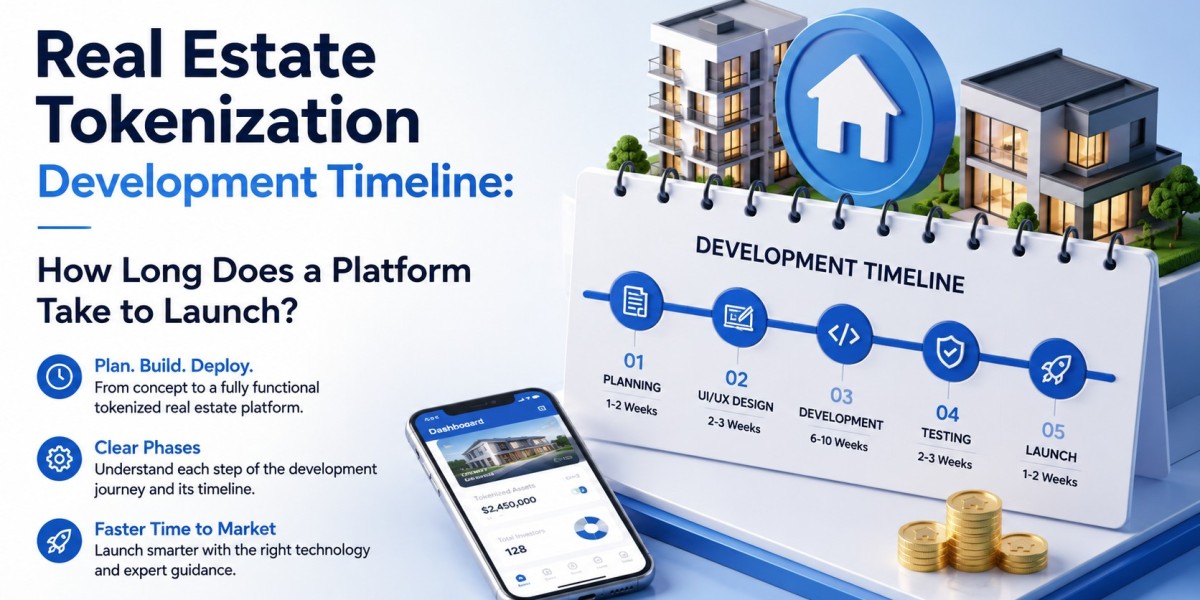
However, launching such a platform is not a matter of developing a website and adding a token sale feature. The timeline depends on property selection, legal structure, token design, blockchain choice, smart contract development, investor onboarding, payment systems, compliance requirements, marketplace functions, and security testing. A simple platform may take around 3 to 5 months, while a more feature-rich project can take 6 to 12 months or longer.
For a business working with a real estate tokenization company, understanding the development timeline helps with budgeting, staffing, legal preparation, and launch planning. This article explains the major stages involved in real estate tokenization development and the approximate time each stage can take.
Average Real Estate Tokenization Platform Development Timeline
The development period varies according to the platform's functions and regulatory requirements. A basic platform with property listings, investor accounts, token issuance, wallet integration, and a simple dashboard may require approximately 3 to 5 months.
A medium-sized platform with marketplace functions, investor verification, payment processing, smart contracts, portfolio management, secondary trading, and administrative controls may require around 5 to 8 months. A large platform supporting several asset classes, multiple jurisdictions, sophisticated compliance procedures, secondary markets, and extensive integrations can take 8 to 12 months or more.
The timeline can also change when legal documentation, property due diligence, licensing, third-party integrations, or security audits take longer than expected.
Stage 1: Business Planning and Requirement Analysis
Estimated time: 2 to 4 weeks
The first stage involves deciding what the platform will offer and who will use it. A business may target individual investors, institutions, property developers, investment funds, or a combination of these groups.
During this phase, the development team defines the property categories, investment model, token structure, supported currencies, investor eligibility rules, transaction flow, and revenue model. The team also decides whether the platform will support primary token sales only or provide a secondary trading facility.
A real estate asset tokenization company may also review the type of ownership being represented by the token. Depending on the legal structure, tokens may represent shares in a legal entity that owns a property, participation rights, debt interests, or another legally defined financial interest.
This stage usually produces a product specification, feature list, technical plan, and preliminary development schedule.
Stage 2: Legal and Regulatory Planning
Estimated time: 3 to 8 weeks
Legal preparation is one of the areas that can affect the launch date considerably. Real estate tokenization involves both property ownership and digital assets, so the legal model needs careful review.
The business may need to assess securities regulations, property laws, investor eligibility, anti-money laundering requirements, know-your-customer procedures, taxation, custody arrangements, data protection, and restrictions on secondary trading.
A legal team can determine how property ownership should be structured and what rights token holders receive. The development team then uses these decisions when designing token contracts, investor workflows, and platform permissions.
For this reason, legal planning should begin early rather than waiting until the software is almost finished.
Stage 3: UI and UX Design
Estimated time: 2 to 4 weeks
Once the platform requirements are defined, designers prepare the user experience. The interface may include investor registration, property listings, investment details, token balances, transaction history, wallet information, portfolio data, and administrative functions.
The property page should present information such as property type, location, valuation, expected returns, token price, minimum investment, ownership structure, and relevant documents.
The design process normally begins with wireframes and user flows. These are followed by interface designs for desktop and mobile screens. The final layouts are then handed to developers for implementation.
A simple investor portal can take less time, while platforms serving different user categories may require additional screens and workflows.
Stage 4: Blockchain and Technical Architecture
Estimated time: 2 to 4 weeks
The technical team selects the blockchain network, token standard, wallet approach, database structure, hosting environment, and integration architecture.
The blockchain choice can depend on transaction fees, network activity, token standards, ecosystem support, wallet compatibility, and business requirements. The platform may use a public blockchain, private network, or another blockchain architecture depending on its operating model.
The architecture normally includes the web application, backend services, database, blockchain layer, smart contracts, wallet integration, payment services, identity verification, and administrative systems.
At this stage, the team also defines how off-chain property records and on-chain token records will communicate.
Stage 5: Smart Contract and Real Estate Token Development
Estimated time: 3 to 6 weeks
Smart contracts control important blockchain activities such as token issuance, transfers, ownership records, investment rules, and other transactions.
Real estate token development requires careful consideration of the rights associated with each token. The contract may include restrictions on transfers, investor eligibility checks, supply limits, distribution rules, and administrative permissions.
The development team first creates the contract specification and then writes the smart contracts. Testing takes place on a test network before the contracts are prepared for production use.
Because a contract error can affect financial transactions, security testing should receive considerable attention during this stage.
Stage 6: Backend and Platform Development
Estimated time: 5 to 10 weeks
Backend development connects the user interface with blockchain services, databases, identity verification systems, payment providers, wallets, and administrative tools.
Investor registration may include account creation, KYC verification, document submission, approval status, wallet connection, and investment eligibility. Property owners may receive separate functions for submitting property information and documentation.
The administrative dashboard can provide controls for property listings, investors, token supply, transactions, compliance records, reports, and platform settings.
A marketplace can add another layer of development. It may include buy and sell orders, token pricing, transaction records, investor restrictions, and settlement procedures.
The duration depends heavily on the number of functions included in the first release.
Stage 7: Wallet, Payment, and KYC Integrations
Estimated time: 2 to 5 weeks
A real estate tokenization platform often requires several external services. Wallet integration allows users to hold and transfer tokens, while payment systems support investment transactions.
KYC and AML providers can be connected to verify investor identities and collect required information. Payment gateways may support bank transfers, card payments, or digital currencies depending on the platform's legal and operational model.
Each external integration requires development, testing, authentication setup, error handling, and compliance review. If several providers are involved, this phase can add additional weeks to the schedule.
Stage 8: Testing and Security Audit
Estimated time: 3 to 6 weeks
Testing begins throughout development, but a dedicated testing phase is required before launch. Developers and QA specialists examine account creation, property listings, token transactions, wallet functions, payments, investor verification, permissions, and administrative controls.
Smart contracts should undergo separate security reviews because weaknesses in contract logic can create financial risks. Depending on the project, an external security audit may also be conducted.
Performance testing checks how the platform behaves when many users access dashboards, browse properties, submit transactions, or interact with marketplace functions.
Any major issue found during this stage can add time to the launch schedule, so testing should not be treated as a final-day activity.
Stage 9: Deployment and Launch Preparation
Estimated time: 1 to 3 weeks
After testing and security reviews, the platform is prepared for production deployment. The team configures hosting, databases, blockchain contracts, monitoring systems, payment connections, domain settings, user permissions, and production wallets.
The business may also conduct a limited release before opening the platform to a wider audience. A small group of users can test registration, verification, investment, token receipt, and other activities.
This period also gives the operations team time to prepare customer support procedures, investor documentation, property materials, and platform policies.
Stage 10: Public Launch
Estimated time: 1 to 2 weeks
The final launch involves opening the platform to its intended users and monitoring activity closely. The team watches transaction performance, registration rates, verification issues, payment failures, blockchain activity, and user feedback.
A gradual launch can reduce operational pressure. The business can begin with a limited number of properties and investors before adding more assets.
Once the platform has stable operations, additional property categories, investment models, marketplace functions, and integrations can be introduced in later releases.
Factors That Can Change the Development Timeline
Several factors can make real estate tokenization development faster or slower.
Platform Complexity
A basic platform with property listings and token management requires less development time than a marketplace with secondary trading, automated distributions, multiple payment methods, and several user roles.
Regulatory Requirements
Projects operating across multiple countries may require different investor verification procedures and legal structures. Regulatory reviews can therefore add significant time.
Property Due Diligence
The technology may be ready while the property documentation is still under review. Valuation reports, ownership documents, legal agreements, and other records can affect the launch schedule.
Blockchain Selection
Choosing a blockchain with suitable token standards and wallet support can reduce technical complications. A less familiar network may require additional development and testing.
Third-Party Integrations
KYC providers, payment gateways, custody services, analytics systems, and external data providers can introduce dependencies into the project schedule.
Security Requirements
Projects dealing with substantial property values may require several rounds of testing and external audits. More extensive security checks generally add time but can reduce technical risks.
MVP vs Full Platform Timeline
Businesses do not always need every feature at launch. An MVP can focus on property listings, investor registration, KYC, token issuance, wallet integration, investment transactions, and an administrative dashboard.
Such a version may take approximately 3 to 5 months, depending on the project requirements.
A full platform may include secondary trading, automated distributions, multiple property types, portfolio management, advanced reporting, multi-chain support, institutional accounts, and additional compliance functions. This type of project may require 6 to 12 months or more.
Starting with a focused version can help a business evaluate its operating model before investing in a larger release.
How to Shorten the Development Schedule
The timeline can be reduced through proper preparation rather than skipping testing or legal work. Businesses should finalize the business model before development begins, prepare property documentation early, select third-party providers in advance, and establish the legal structure before token contracts are finalized.
Working with an experienced real estate tokenization development company can also reduce repeated development cycles because the team may already understand token standards, wallet connections, smart contract workflows, and investor dashboards.
A business considering real estate tokenization platform development should also prepare a detailed feature list. Removing unnecessary features from the first release can keep the initial project focused.
How to Choose a Real Estate Tokenization Development Company
When comparing a real estate tokenization development company, businesses should examine blockchain experience, smart contract knowledge, security practices, integration capabilities, previous tokenization projects, and post-launch support.
It is also useful to review how the provider handles legal and technical coordination. Technology alone does not determine whether a tokenization platform can operate successfully. Property documentation, investor rules, compliance procedures, and token rights all influence the final product.
Businesses researching the market may compare Top real estate tokenization companies and Best real estate tokenization companies based on project experience, development approach, technical expertise, support services, and pricing.
A reliable real estate tokenization company should also provide a realistic project schedule instead of promising an unusually short launch period without considering legal, security, and testing requirements.
Final Thoughts
The time required for real estate tokenization development depends on the platform's feature set, legal model, blockchain architecture, integrations, property preparation, and security requirements. A focused MVP can take around 3 to 5 months, while a larger platform may require 6 to 12 months or more. Businesses should plan each stage from requirements and legal preparation through smart contracts, backend development, integrations, testing, and deployment rather than treating launch as a single development task. Selecting the right real estate asset tokenization company can help coordinate these activities and reduce avoidable delays. Blockchain App Factory provides Real estate tokenization development services that cover the technical requirements involved in creating and launching real estate tokenization platforms.
FAQs
1. How long does real estate tokenization platform development take?
A basic platform may take around 3 to 5 months, while a feature-rich platform can take 6 to 12 months or longer.
2. What takes the most time during tokenization platform development?
Legal preparation, smart contract development, backend development, integrations, security audits, and regulatory reviews can account for a significant portion of the project timeline.
3. Can a real estate tokenization platform launch in three months?
A focused MVP may be possible within three months when the legal model, property documentation, technical requirements, and third-party integrations are already prepared.
4. Does blockchain selection affect the development timeline?
Yes. Blockchain compatibility, token standards, wallet support, transaction costs, and developer resources can affect development and testing time.
5. How long does real estate token development take?
Real estate token development may take around 3 to 6 weeks for contract creation, testing, and review, although the exact period depends on token functions and compliance requirements.
6. Is a security audit necessary for a real estate tokenization platform?
A security review is highly advisable because the platform can manage valuable assets and financial transactions. Smart contracts should receive particular attention before production deployment.
7. What is the difference between an MVP and a full tokenization platform?
An MVP usually contains the functions needed to test the business model, while a full platform may include marketplace trading, portfolio tools, multiple payment methods, additional property categories, institutional features, and wider integrations.
8. Can businesses add features after launch?
Yes. A platform can begin with a focused feature set and receive additional functions through later development phases, provided the architecture and legal model support those additions.