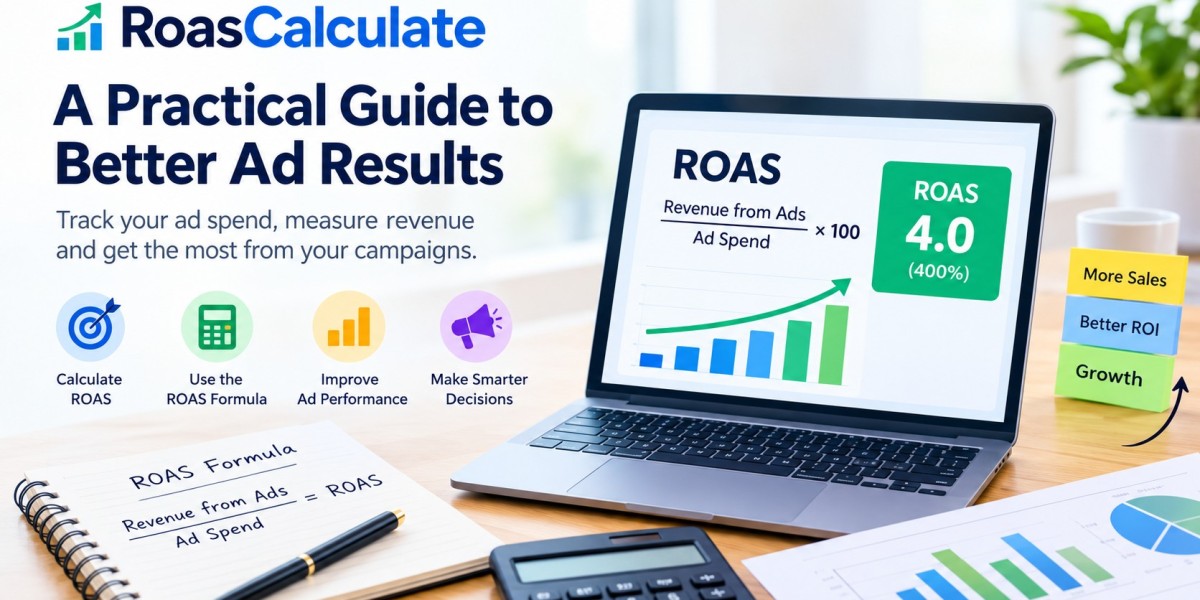

Digital advertising helps businesses reach potential customers, promote products, and generate sales. However, spending money on ads does not always guarantee a good return. Businesses need to track their advertising costs and revenue to understand which campaigns perform well. Return on ad spend (ROAS) is a useful metric that connects advertising expenses with the revenue generated from those ads. Learning how to calculate ROAS helps marketers make informed decisions, manage budgets, and improve campaign performance. RoasCalculate makes this process easier by helping users understand advertising returns and measure campaign results.
What Is Return on Ad Spend (ROAS)?
Return on ad spend measures how much revenue a business earns for every unit of money spent on advertising. It helps marketers evaluate whether their campaigns generate enough revenue to justify their costs.
For example, if a business spends $500 on an advertising campaign and generates $2,000 in attributed revenue, its ROAS is 4:1. This means the campaign generates $4 in revenue for every $1 spent on ads.
ROAS is useful for online stores, digital marketing agencies, small businesses, and companies running paid campaigns on search engines or social media platforms. It provides a simple way to compare advertising performance across campaigns.
Understanding the ROAS Formula
The ROAS Formula is straightforward and easy to apply to advertising data.
ROAS = Revenue Generated from Ads ÷ Advertising Cost
Suppose an online store spends $1,200 on paid advertising and generates $4,800 in attributed sales. The calculation is:
ROAS = $4,800 ÷ $1,200 = 4
The result is a 4:1 ROAS, or 400% when expressed as a percentage. This calculation shows that the campaign generated four dollars in revenue for every dollar spent on advertising.
However, revenue is not the same as profit. Product costs, shipping, employee salaries, software subscriptions, and other business expenses may reduce the final profit. Marketers should consider these costs before deciding whether a campaign is financially successful.
How to Calculate ROAS for Your Campaigns
To calculate ROAS accurately, businesses need reliable advertising and revenue data. Follow these steps to measure campaign performance.
Step 1: Identify Your Advertising Spend
Start by determining how much money you spent on the campaign during a specific period. For example, you might review a weekly campaign budget of $300 or a monthly advertising budget of $2,000.
Use the same reporting period when comparing advertising expenses and attributed revenue.
Step 2: Measure Attributed Revenue
Next, identify the sales revenue linked to your advertising campaign. Advertising dashboards, website analytics, and ecommerce reports can help you track conversions and sales.
Make sure your tracking method is consistent. Different platforms may attribute the same sale to different marketing channels, so avoid adding overlapping revenue figures together.
Step 3: Apply the Formula
Divide the attributed revenue by the advertising cost. If your campaign generated $3,600 in revenue from $900 in advertising spend, your ROAS would be 4:1.
When you calculate roas regularly, you can compare campaign performance, identify changes, and make better budget decisions.
Why ROAS in Marketing Matters
ROAS in Marketing helps businesses understand whether their advertising efforts generate measurable revenue. It also provides useful information when deciding where to allocate advertising budgets.
For example, imagine a business runs two campaigns. Campaign A spends $400 and generates $1,600 in revenue. Campaign B spends $600 and generates $1,800.
Campaign A delivers a 4:1 ROAS, while Campaign B delivers a 3:1 ROAS. Although Campaign B generates more total revenue, Campaign A produces more revenue per advertising dollar.
This comparison can guide future testing and budget allocation. However, marketers should also consider profit margins, conversion quality, customer lifetime value, and campaign objectives before choosing a winner.
Common Factors That Affect ROAS
Several factors influence advertising returns, and understanding them helps marketers improve their results.
- Audience targeting: Reaching people who are more likely to purchase can improve conversion rates.
- Ad creative: Relevant images, clear messaging, and strong calls to action can encourage engagement.
- Landing pages: Fast-loading pages with useful information can reduce friction during the buying process.
- Product pricing: Competitive prices and suitable offers may influence purchasing decisions.
- Conversion tracking: Incorrect or incomplete tracking can make campaign results misleading.
Review these factors regularly instead of relying on ROAS alone. A campaign may show strong revenue but still perform poorly if its expenses are too high.
Using RoasCalculate to Track Advertising Performance
Using RoasCalculate can help marketers understand advertising calculations and review campaign results more efficiently. Instead of performing every calculation manually, users can organize their revenue and advertising cost figures to evaluate returns.
For example, a business that spends $1,500 and earns $6,000 in attributed revenue has a 4:1 ROAS. If spending remains unchanged but revenue increases to $7,500, the ROAS rises to 5:1.
This example shows how changes in revenue can affect campaign efficiency. Marketers can use these calculations to compare reporting periods and identify campaigns that deserve further testing.
RoasCalculate also provides a useful starting point for businesses learning to calculate ROAS and interpret their advertising data. For better decisions, combine the calculation with accurate conversion tracking and a review of total business costs.
Practical Ways to Improve Ad Results
Improving advertising performance requires regular testing and careful measurement. Start by reviewing your existing campaigns to identify which audiences, advertisements, and landing pages generate the most valuable conversions.
Test one major variable at a time when possible. For instance, compare two headlines while keeping the audience and budget similar. Allow enough time and collect sufficient data before making decisions based on the results.
Set clear campaign goals, monitor spending, and review performance consistently. Avoid increasing budgets simply because a campaign generates clicks or impressions. Focus on meaningful conversions and the revenue associated with them.
Finally, remember that a high ROAS does not automatically mean a business is profitable. Calculate your margins and account for other costs to understand the full financial impact of advertising.
Conclusion
ROAS gives businesses a practical way to measure advertising revenue against campaign spending. By understanding the formula, tracking reliable data, and reviewing results regularly, marketers can make better decisions about their advertising budgets. RoasCalculate can support this process by simplifying the calculation and helping users understand their campaign performance. Consistent measurement, controlled testing, and attention to profitability can help businesses work toward better advertising results.
Frequently Asked Questions
1. What does ROAS mean?
ROAS stands for return on ad spend. It measures the revenue generated for each unit of money spent on advertising.
2. How do you calculate ROAS?
Divide the revenue attributed to advertising by the total advertising cost for the same reporting period.
3. What is a good ROAS?
A good ROAS depends on profit margins, operating costs, industry standards, and business goals. There is no single target that suits every business.
4. Is ROAS the same as ROI?
No. ROAS compares advertising revenue with advertising spend, while return on investment (ROI) measures profit or loss relative to investment costs.
5. Can RoasCalculate help marketers?
RoasCalculate can help users understand and perform ROAS calculations, making it easier to review advertising efficiency and compare campaign results.